There is a moment most gardeners hit in late summer: a low, dense mound covered in pink, magenta or white flowers, and a label lost long ago to the slugs. Heather, obviously. But which one?
That is usually where the questioning stops, because "heather" covers three separate genera that look broadly alike from a few feet away. Calluna, Erica and Daboecia are not interchangeable in the garden — they differ in soil, pruning and season — and telling them apart is easier than it looks. You only need to check three features: how the leaves sit on the stem, what the flowers look like up close, and when the plant blooms. Get those right and you can name most heathers in about ten seconds, without a key.
The three genera, briefly
Calluna is just one species, Calluna vulgaris, known as ling or Scotch heather. It is the plant behind most of the garden cultivars with names like 'Silver Knight' or 'Robert Chapman'. Erica is the large genus, running to hundreds of species worldwide, of which a handful do the heavy lifting in gardens: E. carnea, E. ×darleyensis, E. cinerea, E. tetralix, E. vagans and the tall E. arborea. Daboecia is the smallest group, essentially D. cantabrica and its close relative D. azorica, grown for flowers that are noticeably bigger than anything Calluna offers.
Leaves: the fastest way to tell them apart
Forget the flowers for a moment. Turn a stem between your fingers and look at the node, where the leaves meet the wood. This single feature settles most arguments.
- Calluna: leaves sit in opposite pairs, pressed close to the stem and overlapping like tiny roof tiles. They are minute — often barely 1–2mm — and arranged in four rows, so the shoot looks braided or slightly four-sided. Run a finger up a stem and it feels like a soft bottle brush.
- Erica: leaves grow in whorls of three or four, occasionally five, and stand out from the stem rather than clinging to it. They are needle-like, usually 3–8mm, often dark green above and paler beneath, and they feel rigid and slightly prickly. Erica tetralix is the giveaway in this group: its four leaves sit in a neat cross, which is why it is called cross-leaved heath.
- Daboecia: leaves are alternate — one at a time, spiralling up the stem — and much larger, typically 10–15mm. They are oval, leathery and glossy dark green on top, with white woolly undersides and a rolled edge. You can pinch one flat between finger and thumb; you cannot do that with the other two.
If you have a hand lens or a phone camera with a close-up mode, photograph a single node from the side. The difference between a scale-like leaf hugging the stem and a needle angled away from it is obvious in a photograph, and much easier to compare later.
Flowers: shape, size and position
Once the plant is in bloom, the flowers confirm what the leaves suggested.
Calluna
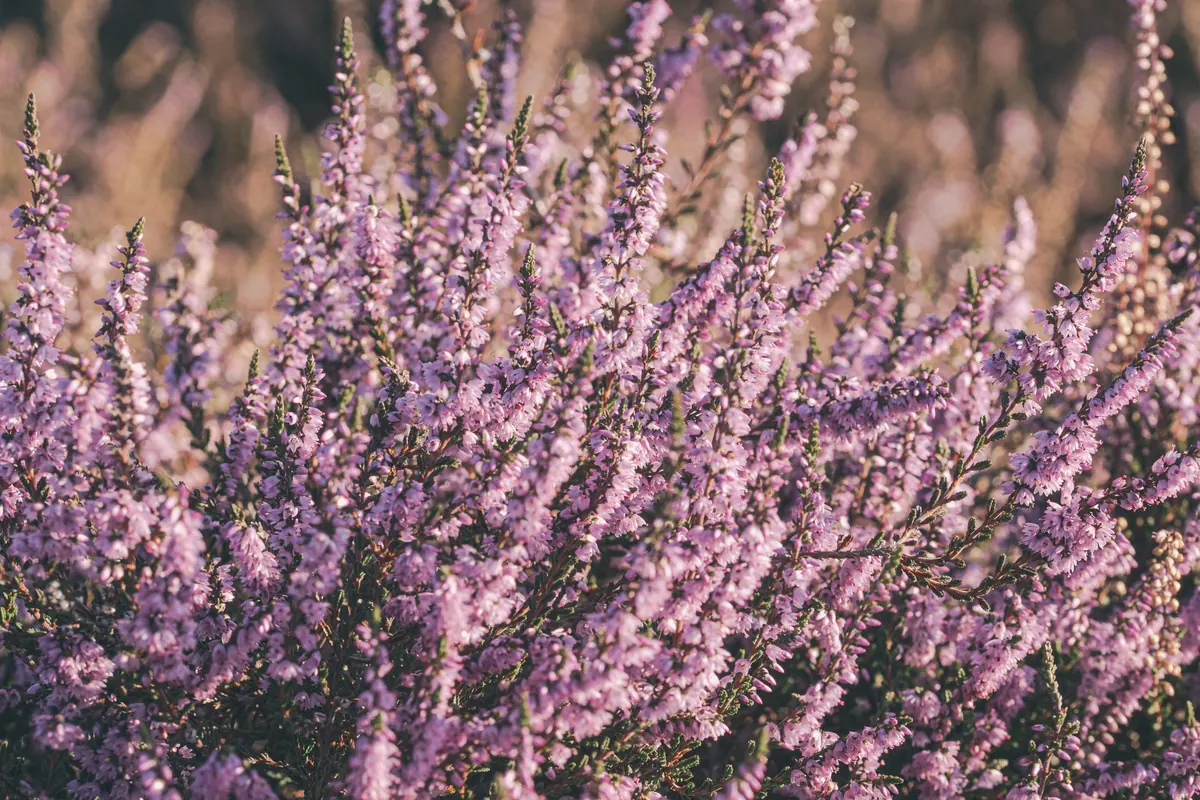
Flowers are carried in long leafy spikes along the top third of the stems, so the plant looks like a bundle of small, upright, flowering wands. Each individual flower is small — a few millimetres — and the colourful part you notice is actually the four-lobed calyx, which is longer than the true petals inside it. That is why Calluna colours read as four neat little segments. Cultivars sold as "bud-blooming" never open fully, which is how they hold their colour through winter.
Erica
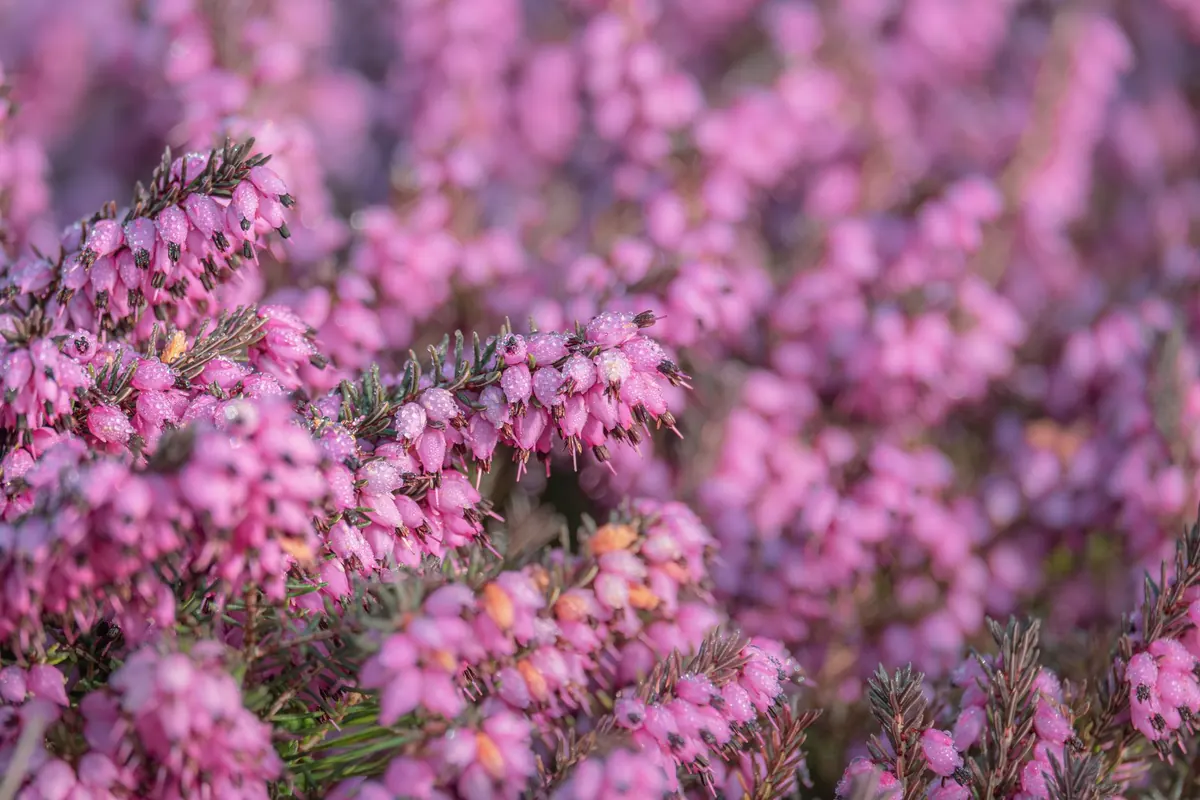
Flowers are bell-shaped or tubular and often hang downwards, singly or in loose clusters. The winter heathers, E. carnea and E. ×darleyensis, carry short leafy spikes of dangling bells low on the plant. E. cinerea has neat, rounded, glossy bells in loose spikes in summer. E. tetralix is different again: its flowers sit in a compact cluster right at the tip of the shoot, like a small pink egg-cup with a pinched mouth. E. arborea is a tall shrub in mild gardens, with scented white bells in spring.
Daboecia
This is the one that makes people stop and look. The flowers are large — roughly 8–12mm — urn-shaped, with a slight waist and a flared mouth, and they hang along a long one-sided spike that keeps extending through the season. Colours run from deep purple-pink to near-white. If a heather flower is big enough to examine comfortably with the naked eye, it is probably Daboecia.
Bloom time narrows the field fast
Heathers are unusually generous with this clue, because their flowering windows barely overlap.
- Late winter to mid spring: Erica carnea and E. ×darleyensis. Nothing else is in flower then.
- Mid to late spring: E. arborea, on tall stems, white and scented.
- Early to late summer: E. cinerea and E. tetralix.
- Late summer into autumn: E. vagans, with its long, whippy flower spikes.
- Late summer to mid autumn: Calluna, peaking in August and September.
- Midsummer until the first frosts: Daboecia, which will keep going well into October if you deadhead the spent spikes.
A useful rule of thumb: flowering before Easter means an Erica; a bristly mound of tiny flowers in mid-August usually means Calluna; a big-flowered purple spike in September is almost certainly Daboecia.
Soil and setting give you a second clue
Where a heather is thriving tells you something too. Calluna, E. cinerea, E. tetralix and Daboecia all want acid ground and will sulk, yellow and open up in the middle on chalk. Erica carnea and E. ×darleyensis tolerate lime and are the reliable choice for a neutral or alkaline border, which explains why they turn up in so many front gardens on heavy clay. Erica vagans is also more forgiving of lime than its summer cousins. If a heather has survived a decade in chalky soil, it is very unlikely to be Calluna.
A five-step field check
- Note the date. Check the bloom calendar above before you look at anything else.
- Turn a stem and count the leaves at one node. Opposite pairs: Calluna. Whorls of three to five: Erica. One at a time: Daboecia.
- Measure or estimate a leaf. Under 3mm and scale-like: Calluna. 3–8mm and needle-like: Erica. Over 10mm and flat: Daboecia.
- Look at the flower. Four small coloured lobes on a spike: Calluna. Hanging bell or tip cluster: Erica. Large urn on a long one-sided spike: Daboecia.
- Check the soil beneath. Acid and peaty supports all three; chalk narrows it to the lime-tolerant Ericas.
Practising on purpose
The quickest way to make this knowledge stick is to plant a comparison row. Put a Calluna, an Erica carnea and a Daboecia within a few feet of each other, label them clearly and photograph each one monthly through a full year. Within twelve months you will have a personal reference set, and the leaf check in step two will take you seconds rather than minutes.
Pruning habits differ too, and once you know your plants you can treat them properly: clip Calluna and the summer Ericas lightly right after flowering, trim the winter heathers once they finish in spring, and simply deadhead Daboecia to keep it flowering. Identification is not the end of the job — it is what makes the rest of the job make sense.
Photo: Ylanite Koppens / Pexels