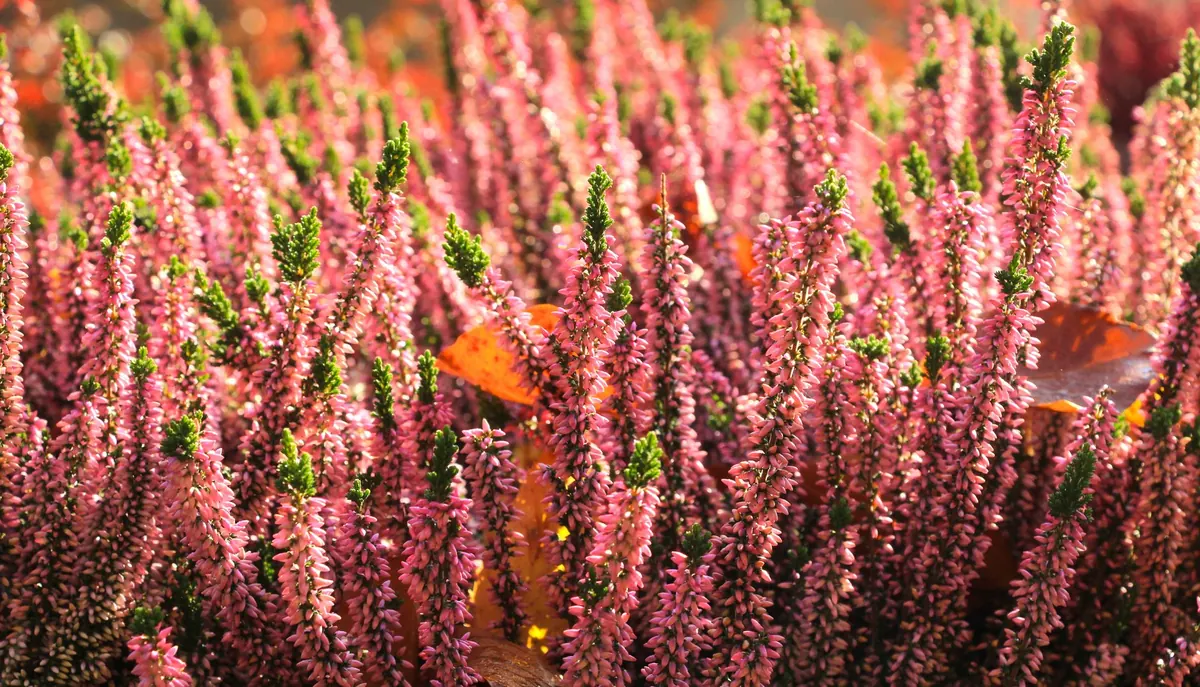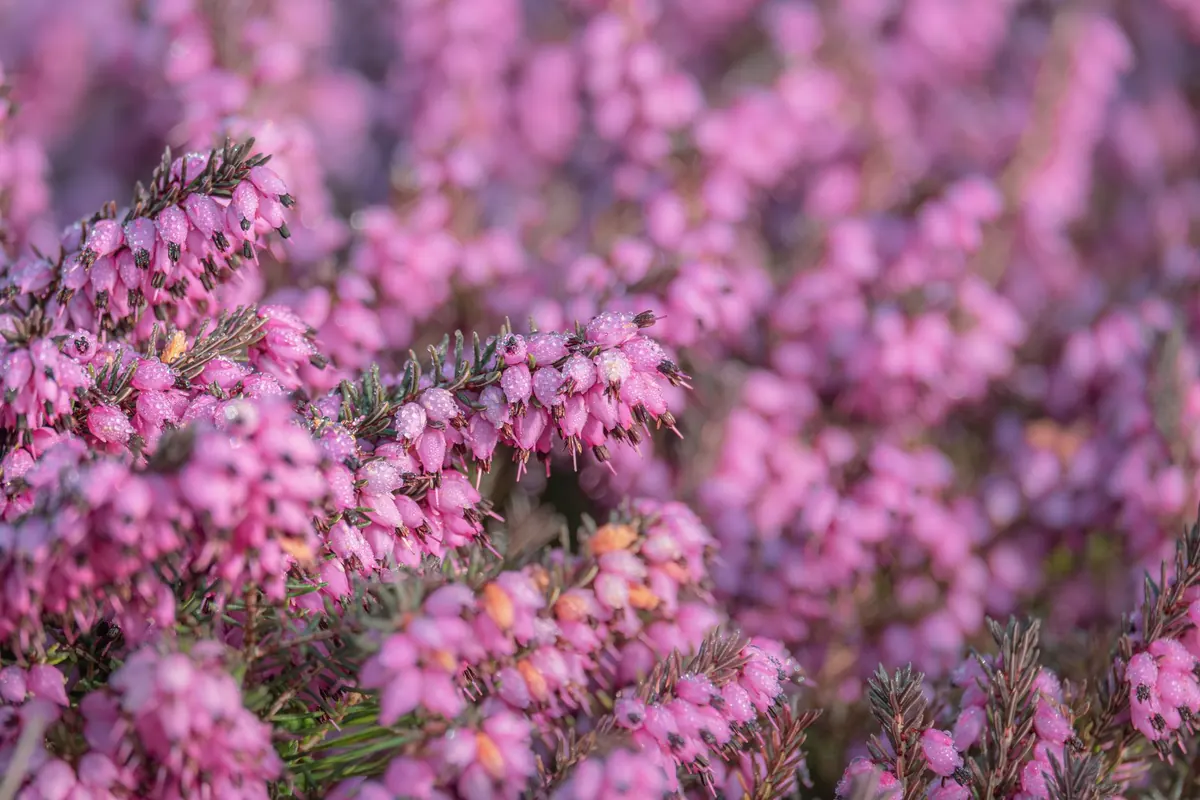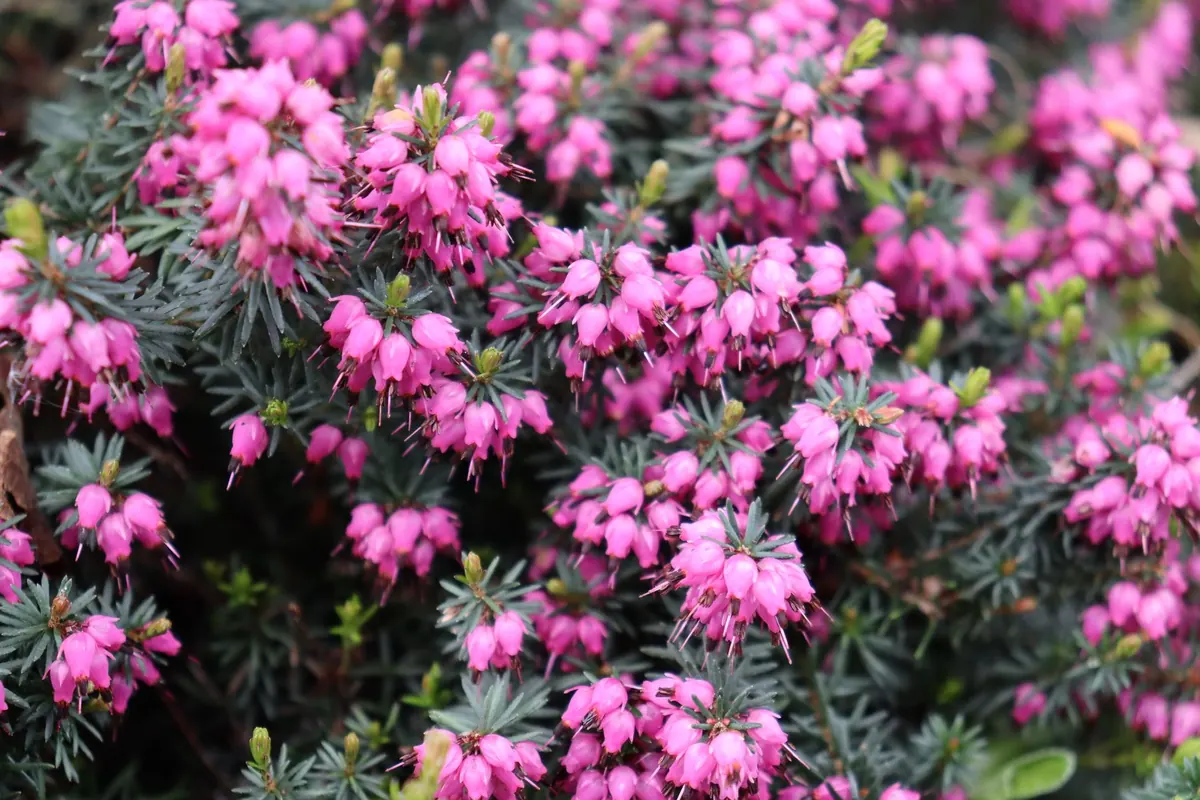
Leave a heather unpruned for a few seasons and it will tell you so: a bare, woody centre, stems splaying outward, and a thin halo of flowers round the edge. The remedy is one of the easiest jobs in the garden, but the timing differs between Calluna, Erica and Daboecia, and cutting in the wrong place can leave a plant that never looks right again. Here is how to work out what you are growing, when to sharpen the shears, and how much to take off.
Most heather disappointment comes from treating a whole group of plants as though it were one. It is not. A winter heather in a pot by the front door, a purple sweep of Calluna across a Welsh hillside and a shrubby Erica arborea in a Mediterranean border are cousins, not clones. They flower in different seasons, they grow at different speeds, and they respond to the blades in different ways. Get the identification right and a fifteen-minute job once a year will keep a plant looking tight and floriferous for two decades. Get it wrong and you will either cut off next year's flowers or slice into wood that will never shoot again.
Why a Yearly Trim Pays Off
Heathers are dwarf shrubs, not ground cover that renews itself from the base. Each year's growth pushes the stems a little further out, and the older wood behind it gradually sheds its leaves. Left alone, a healthy plant becomes a hollow mound: dense at the edges, dead in the middle, and prone to rocking in winter wind.
A light annual cut fixes that. Trimming forces buds lower down the stems to break, so the plant keeps producing young, leafy growth from the inside out instead of only at the perimeter. The result is a cushion that stays solid, flowers evenly across its whole surface rather than in a ring, and holds its shape through winter.
There is a second, quieter benefit. Removing the spent flower spikes and the previous season's soft growth opens the canopy, so air moves through the plant and damp no longer sits against the stems for days on end. Heathers that are never cut tend to rot out in the middle after a wet winter — the classic symptom is a plant that looks fine until you push it and the whole centre gives way.
Know What You Are Growing Before You Cut
The three groups you are most likely to meet behave differently enough that they deserve separate treatment.
Calluna vulgaris (Scotch heather)
This is the true heather of moorland — small, tight, and covered in spikes from midsummer into autumn. The flowers are carried on the current season's shoots, which means prune straight after flowering, usually late September to October, or as late as early November in a mild year. Cut back to just below the faded flower spikes, into the soft growth of the past season. Calluna is the least forgiving about old wood, so keep the shears high.
Erica (the heaths)
Ericas split neatly into two camps by flowering time, and the rule is the same one that governs many shrubs: prune after flowering, never before.
- Winter and spring flowerers — Erica carnea and Erica darleyensis — bloom from January to April. Cut them in April or May, once the colour has faded, trimming the flowering stems back to the base of the flower spike. These are the most forgiving of the group and tolerate a slightly harder cut.
- Summer and autumn flowerers — Erica cinerea, Erica vagans and Erica tetralix — flower from June to October. Trim in late summer or early autumn as the flowers go over, and no later than mid-September so the new growth has time to harden before frost.
- Tree heaths — Erica arborea and Erica lusitanica — are different animals entirely. These are tall, shrubby plants grown for structure and scent. They tolerate hard pruning in spring and, in fact, benefit from it every few years to stop them becoming leggy and bare at the base.
Daboecia (St Dabeoc's heath)
Daboecia flowers on and off from June right through to October, which makes the timing awkward. It also has the useful habit of flowering on both old and new wood. That gives you two options: deadhead lightly as the first flush fades in July, then give it a proper trim in early spring, or simply cut it back hard in March. Daboecia shoots readily from old wood, so you can be braver here than with Calluna — one of the few heathers where a serious rejuvenation cut is genuinely worthwhile.
When to Prune: A Quick Season-by-Season Reference
- March to early April: tidy winter-flowering ericas once the last flowers are brown; hard-prune Daboecia and tree heaths.
- May to June: finish cutting back Erica carnea and Erica darleyensis before the new growth is too far advanced.
- July: deadhead Daboecia for a second flush.
- September to October: the main event — cut Calluna and the summer-flowering ericas immediately after flowering.
- November to February: put the shears away. Cut now and you risk exposing soft new shoots to the worst of the winter, and on spring-flowering types you will be cutting off flower buds you cannot see yet.
How Much to Take Off
Less than most beginners expect. The target is the previous year's growth and a little of the stem beneath the faded flowers — roughly the top third of the leafy canopy, or the top half on a plant that has been missed for a year or two.
The one rule to remember: if you can see bare, brown stem below where the blades are about to land, you are cutting too low. Heathers rarely regenerate from leafless old wood, so every stem you cut into bare bark is a stem the plant has lost for good.
A useful test: run your fingers down a flowering shoot. There is a point where leaves give way to bark. Everything above that point is fair game. Everything below it should stay.
How to Actually Do It
- Wait for a dry day. Wet foliage clumps in the shears and makes clean cuts harder to judge.
- Use the right tool. Bypass hedge shears or small garden snips give a cleaner cut than an electric hedge trimmer, which tears the stems and leaves a ragged surface. On a large bank, a trimmer with a sharp blade is acceptable — just keep the angle shallow and never scalp.
- Work from the outside in. Start at the perimeter, lifting the shears slightly upward as you follow the natural dome of the plant. This shapes the cushion rather than flattening it.
- Cut back to the flower spike base. Take off the old flowers and the stem immediately beneath them, leaving a short stub of leafy growth below each cut.
- Give the centre a light pass. On dense plants, thin out a few of the oldest, longest stems to let light reach the middle. Do not strip it — just open it.
- Sweep up the clippings. Fallen flower spikes and soft stems smother the young growth underneath and make perfect slug cover.
Renovating a Neglected Heather
If a heather has already gone hollow and woody, be honest about the odds. Calluna and the summer ericas almost never shoot from the old framework — you can try a hard cut on one of several plants in a border and see what happens, but expect to replace it rather than rescue it. Winter-flowering Erica carnea and Daboecia are more willing, and a hard cut in early spring will often send them away strongly again.
The middle path is to lift the whole plant, cut away the dead underside of the cushion, replant it slightly deeper so the young perimeter shoots touch the soil, and top-dress with an acid compost. Firm the plant in well, water through the first summer, and keep the centre open. It is slower than starting again, but on a long-established bank it is often the only way to keep the planting intact.
Care After Cutting
- Water in dry spells for the month after pruning, especially on sandy or south-facing ground.
- Never feed with general-purpose fertiliser. Heathers grow on poor acid ground; rich feed produces soft, floppy growth that snaps in the wind. A light mulch of ericaceous compost or leaf mould is plenty.
- Keep the crowns clear of fallen leaves. A build-up around the base is the single most common cause of a heather rotting out in winter.
- Do not prune the same plant twice in one year. Two hard cuts before the plant has rebuilt its canopy is a reliable way to kill it.
Once you are in the habit, the job takes minutes per plant and the difference is obvious within a season: tight, flowering cushions that keep their colour through the grey months, and heathers that go on repaying the same small effort for twenty years instead of fading into sticks.
Photo: Honglei Yue / Pexels